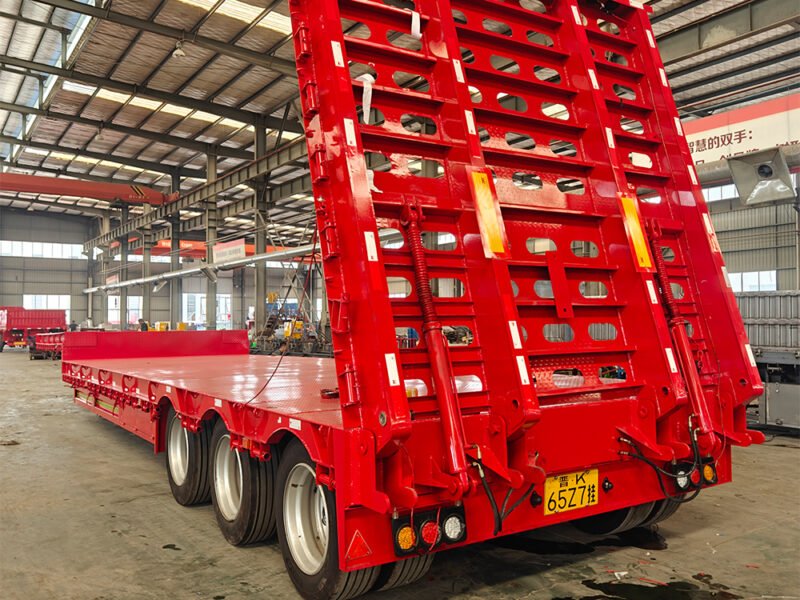
Short answer: To import a semi trailer into Kenya you need three things working together — a licensed customs clearing agent, an Import Declaration Form (IDF) lodged before the trailer ships, and the right conformity document for your configuration. A new trailer is exempt from PVoC under Legal Notice No. 78 of 2020 when it ships with a manufacturer’s warranty or type approval certificate; a knocked-down consignment may be treated as parts, which are in PVoC scope. At Mombasa you then pay import duty (0%, 10% or 25% under the EAC Common External Tariff), VAT at 16%, an Import Declaration Fee of 3.5% and a Railway Development Levy of 2%. Importers must declare the goods within 21 days of discharge.
This guide walks through the documents, the tax arithmetic, and the clearance sequence as published by the Kenya Revenue Authority (KRA), so you can budget a trailer before you place the order.
What documents does KRA require to clear a semi trailer?
KRA’s import guidance lists the documents an importer must hand to a licensed clearing agent. For a trailer consignment, the practical set is:
| Document | Who issues it | Why it matters |
|---|---|---|
| Certificate of Conformity (CoC) | Appointed conformity assessment agent, for regulated products | Without it, a regulated consignment cannot be cleared normally |
| Import Standards Mark (ISM) | Where applicable to the product | Confirms the goods meet the applicable standard |
| Commercial invoice | Exporter | Drives customs value |
| Proforma invoice | Exporter | Used to lodge the IDF before shipment |
| Bill of Lading | Shipping line | Proves the goods and the voyage |
| Freight invoice | Freight forwarder | Freight is part of the CIF value |
| Certificate of origin | Exporter / chamber of commerce | Origin and preferential treatment where applicable |
| Packing list | Exporter | Needed for verification and for CKD/SKD loads |
| KRA PIN certificate | Importer | Identifies the importer of record |
| Import permit / licence | Where the goods are restricted | Applies to specific categories only |
Two points are easy to get wrong. First, the IDF is not a port form — it is lodged by your agent from the proforma invoice and then sent to the supplier so pre-shipment inspection can proceed. Second, the importer of record is the party liable for duty; if a Kenyan distributor buys on your behalf, the PIN and the tax liability sit with them, not with you.
How much duty and tax will you pay on a semi trailer in Kenya?
KRA states the following rates for imports:
- Import duty: between 0%, 10% and 25% as provided by the East African Community Common External Tariff (CET). Sensitive items listed in Schedule 2 of the CET attract duty higher than 25%.
- VAT: the normal rate is 16%; items exempt under the VAT Act 2013 attract 0%.
- Import Declaration Fee (IDF): 3.5% of the value of imports.
- Railway Development Levy (RDL): 2% of the value of imports.
Duty is assessed on the customs value — normally the CIF value (goods + insurance + freight). VAT is then charged on the duty-inclusive value, which is why the effective burden is higher than the headline duty rate suggests.
Illustrative calculation (not a quotation). Assume a CIF value of USD 30,000 and a 25% duty band:
| Line | Basis | Calculation | Amount (USD) |
|---|---|---|---|
| Import duty | CIF × 25% | 30,000 × 0.25 | 7,500 |
| VAT | (CIF + duty) × 16% | 37,500 × 0.16 | 6,000 |
| IDF | CIF × 3.5% | 30,000 × 0.035 | 1,050 |
| RDL | CIF × 2% | 30,000 × 0.02 | 600 |
| Total taxes and fees | 15,150 |
That is roughly 50% of the CIF value in this example. At a 0% duty band the same trailer would land far lower — which is exactly why the HS classification of your trailer, and the band applied to it, deserves confirmation before you commit to a price.
Two practical notes:
- The band depends on the HS line, not on the seller’s description. Semi trailers for the carriage of goods sit in HS heading 8716; the subheading and the national tariff line determine the rate. Ask your clearing agent to show you the line and the rate on the current EAC CET before you sign.
- The agent’s tax bill is the authoritative number. Rates and exempt lists change; the figures above are the rates KRA publishes, but the tax bill generated in the customs system is what you actually pay.
Do you need a KEBS Certificate of Conformity for a semi trailer?
KRA’s document list requires a Certificate of Conformity from the agent for regulated products, and an Import Standards Mark where applicable. Kenya operates a pre-export verification of conformity (PVoC) programme administered by KEBS through appointed agents: the consignment is inspected and certified in the country of supply, before it ships, rather than at Mombasa.
What KEBS actually says about new vehicles. Under Legal Notice No. 78 of 28 April 2020, new motor vehicles and new mobile equipment are exempted from PVoC requirements, provided the consignment is accompanied by a manufacturer’s warranty or a type approval certificate. KEBS states these goods are cleared on the strength of that warranty or type approval certificate rather than on a CoC.
That exemption is the difference between a two-week clearance and a month at the port — and it is a document you obtain before shipment, from the manufacturer. A complete new semi trailer falls in the vehicle / mobile equipment regime, not the general goods PVoC list (KEBS-appointed bodies state plainly that vehicles are exempt from PVoC because they are covered by a separate programme).
The trap is shipping knocked down. If the trailer ships CKD or SKD, the consignment may be declared as parts rather than as a vehicle — and automotive parts and spares sit inside PVoC scope. Kenya also has dedicated rules for unassembled motor vehicles and trailers (Tax Procedures (Unassembled Motor Vehicles and Trailers) Regulations, 2019). Confirm with your agent which declaration your loading configuration produces, before you book the container.
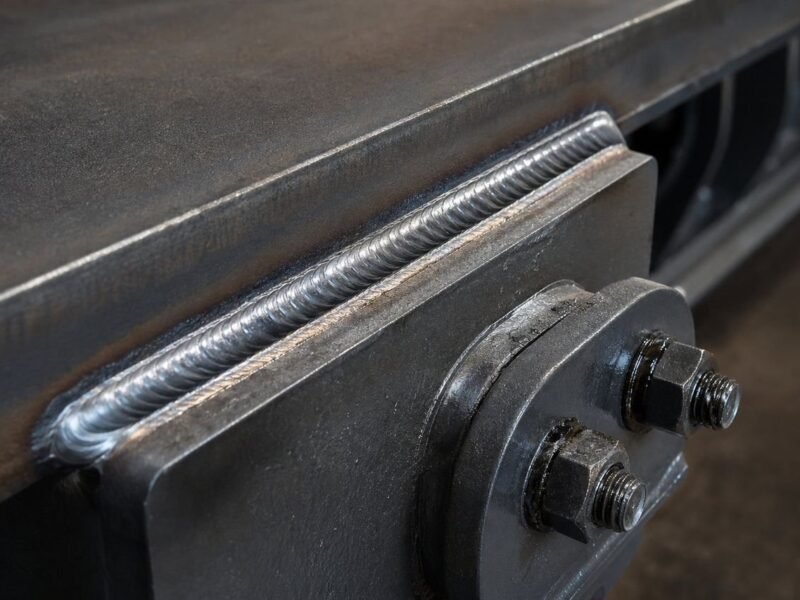
The supplier’s job is to make that inspection boring. For exporters, the file that settles most questions is: commercial invoice and packing list that match the trailer’s dimensions and axle count, the chassis/VIN identification, brake and lighting specification, and photographs of the unit before packing. A manufacturer who ships regularly to Africa usually has this pack ready — Shandong Enxin, for example, photographs each unit at cutting, welding, blasting, painting and final assembly, and sends the inspection record before the container is sealed.
What are the five steps at Mombasa?
KRA describes the import clearance sequence in four stages, preceded by the IDF:
- IDF lodgement. Your agent lodges the Import Declaration Form from the proforma invoice. You send the IDF to the supplier, who uses it for pre-shipment inspection.
- Entry declaration and payment. The agent declares the goods in the customs system and gives you a payment slip. You pay at the bank and return the bank slips to the agent.
- Verification. The agent presents the physical file at the customs station where the goods are held, and physical verification is carried out.
- Clearance and release. Compliant declarations are released.
The legal clock matters: under Section 34 of the East African Community Customs Management Act 2004, goods for importation must be entered within 21 days after discharge begins — or, in the case of vehicles, on arrival. Missing that window is how demurrage and storage charges start.
Does shipping CKD or SKD change what you pay?
Shipping a trailer knocked down inside containers changes the logistics calculation and can change the classification question, because a container of parts is not the same declaration as one assembled unit. It does not automatically reduce duty.
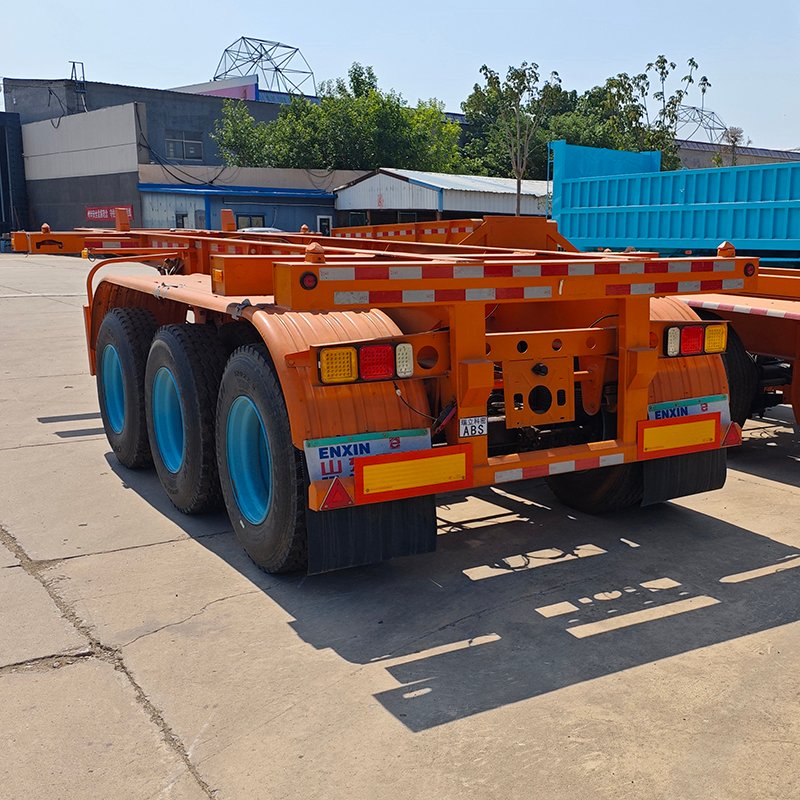
What it reliably changes is ocean freight per unit. A 40HQ container carrying a CKD or SKD trailer usually costs less per trailer than breakbulk or RoRo, and it is the reason most China–Africa trailer volume moves this way. Enxin builds nine trailer families — flatbed and side wall, skeletal container, rear dump, side dump, lowbed, fence and livestock, concrete mixer, car carrier and stake/box — and quotes both CKD/SKD in 40HQ and one-piece shipment so the buyer can compare landed cost rather than freight alone.
Before you choose, ask your agent one question in writing: “If this ships CKD, which HS line will you declare, and what rate applies?” The answer is the difference between a freight saving and an unpleasant surprise.
Kenya vs Ghana at a glance
| Item | Kenya | Ghana |
|---|---|---|
| Duty framework | EAC Common External Tariff: 0% / 10% / 25% (sensitive items higher) | ECOWAS CET five bands: 0% / 5% / 10% / 20% / 35% |
| VAT | 16% standard | 15% standard, plus NHIL and GETFund levies |
| Additional charges | IDF 3.5%, RDL 2% of import value | Examination fee, ECOWAS levy, AU levy, processing fee and others per GRA |
| Conformity | CoC from appointed agent for regulated products; ISM where applicable | Permits from regulatory agencies where the goods require them (e.g. GSA) |
| Declaration system | KRA customs system, via licensed clearing agent | ICUMS, via a customs agent |
| Declaration deadline | 21 days after discharge (EACCMA s.34) | On or after arrival, per GRA import procedure |
| Classification disputes | Resolved with the agent and KRA | Advance ruling available from GRA |
FAQ
Can I import just one semi trailer into Kenya? Yes. There is no minimum consignment size — the constraint is cost per unit, not eligibility. One trailer in a shared container is common for first-time buyers.
Who is legally responsible for duty? The importer of record named on the declaration. If you buy through a Kenyan distributor, they are the importer and the duty is theirs; if you import directly, you need a KRA PIN and a clearing agent.
Can the supplier declare a lower value to reduce duty? No — and it is a bad trade. Customs value is assessed under valuation rules, and an under-declared consignment risks rejection, re-valuation, penalties and delay. The saving is temporary; the record follows the importer.
How long does clearance take at Mombasa? KRA does not publish a guaranteed clearance time, and the answer depends on the verification channel your declaration is routed to. Build your project schedule around verification, not around a best case.
Do I pay VAT if my business is VAT-registered in Kenya? VAT is charged on import. Whether you can recover it depends on your registration and the use of the goods — confirm with your accountant before you budget, because it changes the effective cost materially.
Is a used trailer cheaper to import? The duty treatment follows the classification and the customs value, and used equipment brings its own inspection questions. Compare total landed cost, not the invoice price.
What if the trailer arrives damaged? Inspect before you move it: photographs of the deck, main beams, axles, lights and tyres, with the container seal record. Notify the insurer and the supplier in writing on the same day — most claims fail on documentation, not on facts.
Sources
- Kenya Revenue Authority, Importing and Exporting (duty bands, VAT, IDF 3.5%, RDL 2%, document list, clearance stages): https://www.kra.go.ke/business/companies-partnerships/companies-partnerships-pin-taxes/company-partnership-imports-exemptions
- East African Community, Common External Tariff (duty bands and sensitive items)
- East African Community Customs Management Act 2004, Section 34 (entry within 21 days)
- Kenya Bureau of Standards, Destination Inspection — Legal Notice No. 78 of 28 April 2020: new motor vehicles and new mobile equipment exempt from PVoC with a manufacturer’s warranty or type approval certificate: https://inspection.kebs.go.ke/destination-inspection/
Rates and procedures are as published at the time of writing. Confirm the current rate for your HS line with your clearing agent before you commit to a landed cost.
Related guides: Ghana duty bands and Tema clearance · Nigeria SONCAP and Form M