Short answer: To import a semi trailer into Ghana you need a customs agent, a Taxpayer Identification Number (TIN) or GhanaCard PIN, an Import Declaration Form (IDF) from the Ministry of Trade, and a declaration filed in ICUMS. Duty follows the ECOWAS Common External Tariff — five bands of 0%, 5%, 10%, 20% and 35% — and on top of duty you pay VAT at 15%, the NHIL and GETFund levies, plus the examination, processing and ECOWAS/AU levies that GRA lists for imports.
The single most useful number in your budget is not the duty rate. It is the HS line your trailer is declared under, because that line decides which band applies.
Which HS code applies to a semi trailer in Ghana?
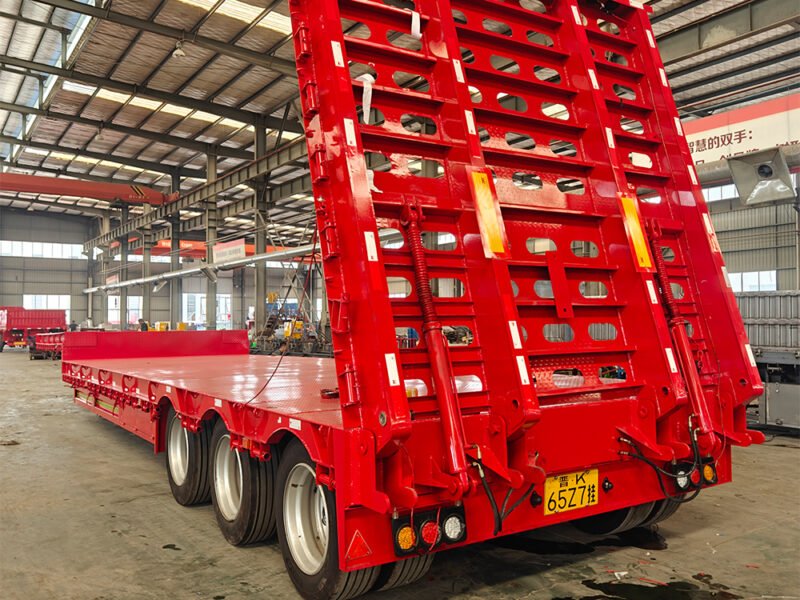
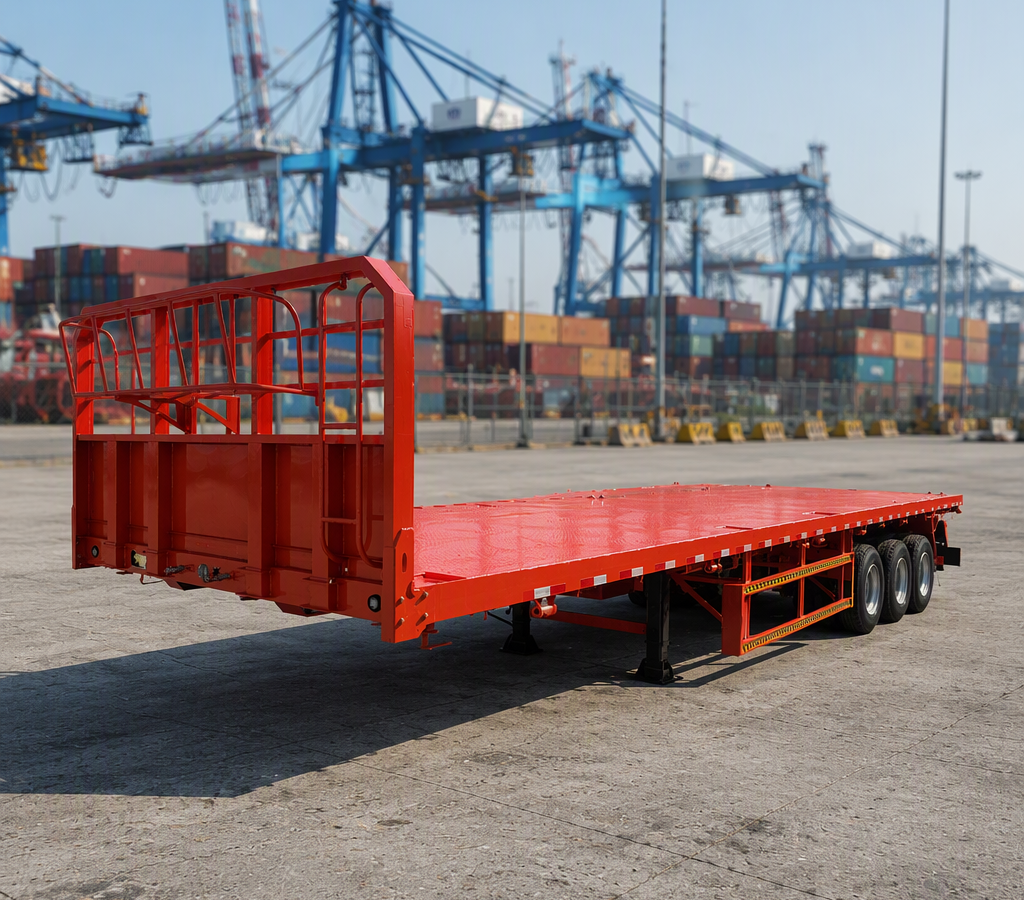
Semi trailers and other non-powered vehicles for the carriage of goods sit in HS heading 8716. Within that heading, the subheading distinguishes trailer types — flatbed, skeletal/container chassis, lowbed, tipper and so on.
Ghana Customs publishes a searchable Harmonized System Code table that returns, for each line, the import duty, import VAT, import excise and NHIL rate. That table — not a blog, not a freight forwarder’s memory — is the reference your agent should be quoting from.
Three practical consequences:
- “Trailer” is not a classification. A 3-axle skeletal container chassis and a 4-axle lowbed may not land on the same line, and a knocked-down unit may be declared differently from a complete one.
- The line drives the band. Under the ECOWAS CET, the five bands run from 0% (essential social goods) to 35% (specific goods for economic development). A one-band difference on a USD 30,000 trailer is USD 1,500–3,000 of duty before levies.
- You can ask, in advance. GRA publishes an Advance Ruling process, including a classification application form. If the value at stake is material, an advance ruling is cheaper than a dispute at the port.
How is import duty calculated in Ghana?
GRA is explicit that the published bands are not import duty alone — they are an imposition that sits alongside:
- Value Added Tax (standard rate 15%)
- National Health Insurance Levy (NHIL)
- Ghana Education Trust Fund (GETFund) levy
- Import Excise Duty
- Examination Fee
- African Union Levy
- ECOWAS Levy
- Processing Fee
- Special Import Levy
- Import Levy
- Interest charges and state warehouse rent where applicable
The calculation runs in a fixed order: customs value (normally CIF) → duty band → duty → VAT and levies on the applicable base → total tax bill. ICUMS generates the tax bill; the bank takes the payment.
What changed in 2026. Under the VAT Act 2025 (Act 1151), effective 1 January 2026, Ghana simplified the computation: VAT at 15%, NHIL at 2.5% and the GETFund levy at 2.5% are now all charged on the same base, instead of levies being stacked into the VAT base first. The 1% COVID-19 Health Recovery Levy was abolished. If you are working from a 2024-era landed-cost template, it overstates the tax.
Illustrative calculation (not a quotation). Assume a CIF value of USD 30,000 and a duty band of 10% — the band shown is an assumption for arithmetic only:
| Line | Basis | Calculation | Amount (USD) |
|---|---|---|---|
| Customs duty | CIF × 10% | 30,000 × 0.10 | 3,000 |
| VAT | (CIF + duty) × 15% | 33,000 × 0.15 | 4,950 |
| NHIL | (CIF + duty) × 2.5% | 33,000 × 0.025 | 825 |
| GETFund | (CIF + duty) × 2.5% | 33,000 × 0.025 | 825 |
| Subtotal before other levies | 9,600 |
Examination, processing, ECOWAS and AU levies are then added on the basis your agent applies. Do not treat the subtotal as a landed cost — treat it as proof that the band, not the freight rate, is the variable that moves your margin.
Two rules that keep this honest:
- Use GRA’s own calculator. GRA links a General Goods Duty Calculator for importers, and the ICUMS tax bill is the authoritative figure.
- Never budget from a duty rate you saw in a blog. Rates and levy bases change; the HS line and the date of declaration decide.
What documents do you need before the trailer arrives?
GRA’s import procedure lists the documents an importer must hold before or at the time the goods arrive:
| Document | Source | Note |
|---|---|---|
| Original waybill or Bill of Lading | Shipping line | Must match the consignee |
| Attested invoice | Exporter | Attestation matters — an unattested invoice creates questions |
| Packing list | Exporter | Essential for CKD/SKD containers |
| Import Declaration Form (IDF) | Ministry of Trade | Not a GRA form — a common point of confusion |
| TIN from GRA, or GhanaCard PIN | GRA / NIA | The importer’s identity in the system |
| Permits from regulatory agencies | e.g. Ghana Standards Authority | Depends on the goods |
For a trailer, the documents that most often cause friction are the attested invoice and the packing list for a knocked-down load. A 40HQ container carrying a CKD trailer is a list of steel sections, axles, suspension, wheels and fittings; if the packing list describes “one semi trailer”, the examination officer has nothing to count against.
Manufacturers who ship to West Africa regularly prepare that list as a matter of course. Enxin, for instance, quotes CKD or SKD in 40HQ containers alongside one-piece shipment, and issues the loading plan and packing list with the shipping documents so the declaration and the container describe the same thing.
What happens at Tema: the ICUMS sequence
GRA describes the clearance route as follows:
- The customs agent submits the declaration in ICUMS, with all the required documents, before or after arrival.
- ICUMS processes it in three stages: classification → valuation → approval.
- Duties and taxes are paid at a participating bank, using the tax bill generated by ICUMS.
- The declaration is verified and an examination officer is selected in ICUMS.
- The consignment is routed by risk channel:
- Red — mandatory physical examination
- Yellow — digital scan
- Green — released at the gate, scanned automatically on the way out of MPS port
- Released goods go to the exit gate for a security check, accompanied by the waybill.
The channel is the part importers cannot control — and the reason a clearance schedule built on a “green channel” assumption usually slips. Budget for red; be pleased with green.
Can you lock the classification before you ship?
Yes, and for a capital item it is worth doing. GRA publishes an Advance Ruling process with a classification application form. A ruling converts your biggest unknown — which band applies — into a written position before the trailer is built.
The sequence that works for a first-time importer:
- Get the specification sheet from the manufacturer (axle count, deck length, payload, trailer type).
- Ask your Ghanaian agent which HS line they intend to declare, and why.
- If the answer is uncertain, apply for an advance ruling on classification.
- Only then finalise the CIF price and the payment schedule with the supplier.
Step 4 matters commercially: if the buyer and seller have agreed a price without knowing the band, one of them absorbs the difference after arrival.
Ghana vs Kenya at a glance
| Item | Ghana | Kenya |
|---|---|---|
| Duty framework | ECOWAS CET: 0% / 5% / 10% / 20% / 35% | EAC CET: 0% / 10% / 25% (sensitive items higher) |
| VAT | 15% standard, plus NHIL and GETFund | 16% standard |
| Declaration system | ICUMS, via a customs agent | KRA customs system, via a licensed clearing agent |
| Import form | IDF from Ministry of Trade | IDF lodged with KRA |
| Risk channels | Red / Yellow / Green | Verification at the customs station |
| Classification certainty | Advance ruling available from GRA | Resolved with the agent and KRA |
| Conformity | Permits where required (e.g. GSA) | CoC for regulated products; ISM where applicable |
FAQ
Do I need a company in Ghana to import a trailer? You need an importer of record with a TIN or GhanaCard PIN, and a customs agent to declare on your behalf. Whether that is your own entity or a local distributor is a commercial decision, and it decides who carries the duty.
Is the duty based on the price I paid or on a GRA value? ICUMS performs valuation on the declaration. Where the declared value is not accepted, GRA applies its own valuation basis — which is why a defensible invoice, freight invoice and insurance document matter.
Can I import a used semi trailer? Used equipment is importable but attracts closer examination and its own valuation questions. Compare the total landed cost against a new unit rather than the sticker price.
How long will clearance take? GRA does not guarantee a clearance time, and the risk channel decides the path. Red-channel examination adds days; that is a planning input, not a surprise.
Can the supplier handle clearance for me? A Chinese manufacturer can prepare documents, but the declaration must be made by a licensed Ghanaian agent for the importer of record. Treat “we will clear it for you” from any overseas supplier as a question, not a promise.
What is the cheapest way to ship a trailer to Ghana? CKD or SKD in a 40HQ container usually lowers freight per unit compared with one-piece or RoRo, and it changes what the packing list must describe. Ask for both freight options and compare landed cost, not freight alone.
What if the classification is disputed after arrival? The declaration is assessed in ICUMS and duty is payable before release; a later dispute goes through GRA’s processes. This is precisely the risk an advance ruling removes.
Sources
- Ghana Revenue Authority, Customs Tariffs and Levies — ECOWAS CET five bands and the full list of import charges: https://gra.gov.gh/customs/customs-tariffs-and-levies/
- Ghana Revenue Authority, Import Procedures — documents, ICUMS stages, payment and risk channels: https://gra.gov.gh/customs/import-procedures/
- Ghana Revenue Authority, Harmonized System Code — duty, VAT, excise and NHIL rates by HS line: https://gra.gov.gh/customs/hs_code/
- Ghana Revenue Authority, VAT — 2026 reform: VAT 15%, NHIL 2.5% and GETFund 2.5% charged on the same base; COVID-19 Health Recovery Levy abolished: https://gra.gov.gh/domestic-tax/tax-types/vat/
- Ghana Revenue Authority, Advance Ruling — classification and origin application guidance
Rates, levy bases and procedures are as published at the time of writing. Confirm the rate for your HS line on GRA’s HS code page or through an advance ruling before you commit to a landed cost.
Related guides: Kenya import requirements (KEBS, KRA) · How GRA values a trailer