In short: A semi trailer is a trailer with no front axle. It couples to a tractor unit through a king pin and fifth wheel, so the tractor carries the front of the load and the trailer carries the rest plus its own weight. That single design decision is why the same trailer can be swapped between tractors in minutes, and why the king pin, the landing gear and the main beam are the parts worth understanding first.
If you are importing your first trailer, the vocabulary is the first obstacle. This page is the plain version: what the thing is, what the parts are called, and which numbers actually decide what it can haul.
The definition, without the jargon
A semi trailer has no front axle of its own. It rests on two things: its own rear axles, and a coupling on the towing vehicle. That coupling is the fifth wheel on the tractor, and the corresponding part on the trailer is the king pin.
The consequence: the tractor carries part of the trailer’s weight, and the trailer carries the rest plus the cargo. That is what makes it a “semi” trailer rather than a full trailer – a full trailer has its own front axle and towbar and carries all of its own weight.
Three parts do the coupling work, and they are the ones to check on any quote:
- King pin. The coupling pin itself. Ours is available in 2 in (50 mm) or 3.5 in (90 mm), bolt-in or welded.
- Landing gear. The legs that hold the trailer up when it is uncoupled. Ours are two-speed heavy duty, rated 28 t.
- Fifth wheel plate area. The underside structure that takes the coupling loads – which is why the main beam matters.
Semi trailer, full trailer, rigid truck – the practical difference
- Semi trailer: no front axle, couples to a tractor. Swappable in minutes, which is why fleets run more trailers than tractors.
- Full trailer: has its own front axle and is towed behind something else. Carries all its own weight.
- Rigid truck: one vehicle, cab and body together. Cannot be separated, so it cannot drop a load and pick up another.
For an importer, the semi trailer’s advantage is flexibility: one tractor can serve several trailers, and the trailer carries no engine, cab or driveline to buy, register or maintain.
The main types, and what each is for
- Flatbed and side wall – general cargo and containers, from 20 ft to 45 ft.
- Skeletal and container chassis – containers only, no deck, lightest option. Compare them in flatbed versus skeleton versus fence.
- Dump and tipper – bulk material, tipping rear or side. See side dump versus rear dump.
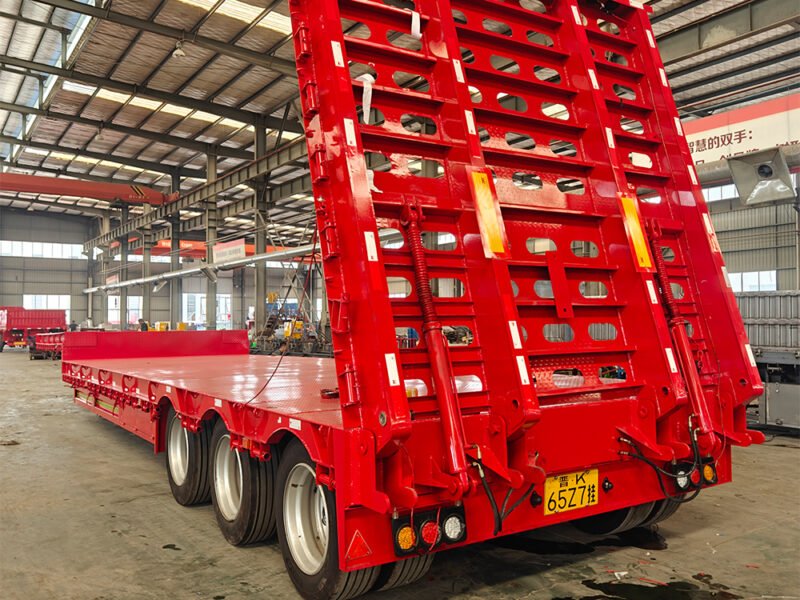
- Lowbed and heavy haul – excavators, rollers and other equipment driven on and off.
- Fence and livestock – livestock and long cargo that needs side containment.
- Concrete mixer – 12-18 CBM agitating drums.
- Car carrier – 7-10 cars.
- Side dump – where the site is too narrow to reverse onto a tip face.
The numbers that decide what it can haul
These are the lines that matter on any specification sheet, ours included:
- Payload and axle rating. Our axle sets are rated 13 t, 14 t, 16 t or 20 t, in two, three or four-axle configurations, and loading capacity runs from 30 t to 100 t depending on the model. Check the rating against your legal gross weight, not against the biggest number on offer – capacity you cannot legally use is tare you carry for nothing.
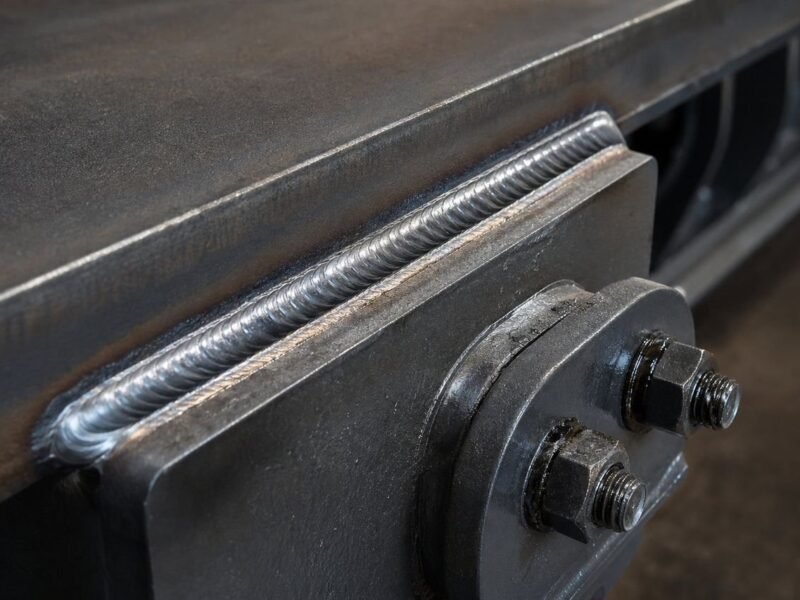
- Main beam. Ours is a 500 mm high I-beam in Q345 high-tensile steel (Q345B on the U-shape mining build), welded with automatic submerged arc processes. Grade and plate thickness together decide capacity – see Q345 versus T700.
- Suspension. Mechanical leaf spring is standard on our builds; air is available on request. See what each type does.
- Twist locks if it carries containers – and how many determine which box sizes it accepts.
- Braking. WABCO RE6 relay valves and T30/30 spring brake chambers are standard on our builds, with 40 L air tanks; ABS is optional.
- Tyres. 12R22.5 tubeless on 9.0-22.5 rims is standard across most of the range.
It may not arrive in one piece
Most semi trailers longer than about 12 m cannot pass through a container door, so they ship knocked down with the frame stacked and the running gear crated. That is normal, not a defect – what CKD means and when to avoid it explains the trade.
What to send a manufacturer
Six answers turn a range into a quote. The list, item by item, is on what to put in a first message; how many units fit in a container is the other number worth having before you commit.
FAQ
What is the difference between a semi trailer and a container chassis?
A container chassis is a specialised semi trailer with no deck, built only to carry containers on twist locks. A flatbed semi trailer can also carry containers but has a deck and does more jobs.
Does a semi trailer need its own brakes?
Yes. A loaded semi trailer is too heavy for the tractor alone to stop safely, so the trailer has its own braking system and air circuit.
What is a king pin?
The coupling pin under the front of the trailer that locks into the tractor’s fifth wheel. Ours comes in 2 in (50 mm) or 3.5 in (90 mm), bolt-in or welded.
How much weight does the tractor carry?
Enough to hold the front of the trailer – which is why the coupling area and the main beam are engineered together rather than separately. The split is set by where the landing gear and king pin sit relative to the axles.
Key facts
- A semi trailer has no front axle; it couples to a tractor through a king pin and fifth wheel.
- Our king pins: 2 in (50 mm) or 3.5 in (90 mm), bolt-in or welded. Landing gear: two-speed heavy duty, 28 t.
- Axle sets rated 13 t, 14 t, 16 t or 20 t; two, three or four axles; loading capacity 30 t to 100 t by model.
- Main beam: 500 mm Q345 high-tensile I-beam, automatic submerged arc welded; Q345B on the U-shape mining build.
- Mechanical leaf spring standard; air suspension on request. WABCO RE6 relay valves; ABS optional.
- Most units over about 12 m ship knocked down because they cannot pass a container door.
Related: how to order, what a 3-axle flatbed costs, and what a factory inspection proves.